
Predict Before Failure
Before failures happen, we assess damage mechanisms and remaining life
PILETA Co., Ltd. is a condition assessment partner to KEPCO power generation subsidiaries, independent power producers (IPPs), refineries and petrochemical plants. We deliver standards-based services, from creep, fatigue and corrosion life assessment to root cause analysis (RCA) and risk-based maintenance (RBM).
Remaining Life Assessment
Life assessment: creep, fatigue and corrosion
We quantify creep, fatigue and corrosion damage in power generation equipment to determine its remaining life. Combined with specialized nondestructive testing (NDT) of gas and steam turbines, this provides a comprehensive condition assessment of critical components.
Creep
High temperature, sustained stress
We quantify deformation and rupture damage in components operating under long-term stress at elevated temperatures.
Fatigue
Cyclic loading
We assess fatigue damage caused by cyclic loading to determine remaining life.
Corrosion
Damage progression
We quantify the progression of corrosion damage to evaluate equipment integrity.
Root Cause Analysis — 4-Step Process
Root cause analysis (RCA)
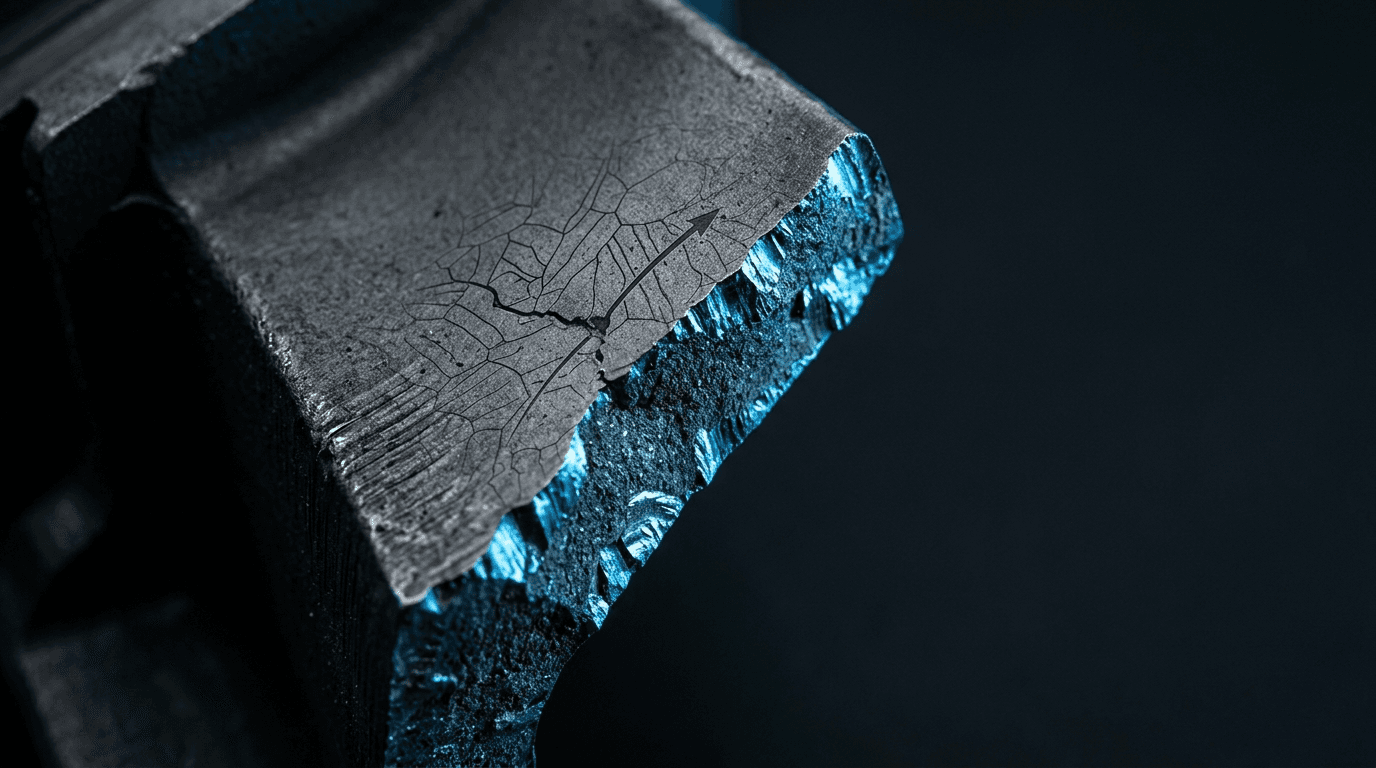
A four-step process, from visual examination to elemental analysis, identifies the cause of damage.
Visual & macro examination
Low-magnification inspection
Macroscopic observation of fracture surfaces, measurement of crack location and length, and initial classification of fracture mode
Microstructure
High-magnification analysis
Scanning electron microscopy (SEM), optical and laser microscopy; analysis of grains, porosity, precipitates and fracture surfaces; deep-learning-based automatic segmentation (MatSAM)
Degradation
Degradation grading
Assessment of creep voids and cavities, morphological classification of gamma prime (γ′) precipitates, and automated rating into four degradation grades (A–D)
EDS analysis
Elemental analysis
Qualitative and quantitative energy-dispersive and wavelength-dispersive X-ray spectroscopy (EDS/WDS), mapping of segregation and diffusion layers, and identification of corrosion and oxidation causes
By reviewing microstructural changes, environmental factors and operating history together, we identify root causes based on quantitative data. Regular RCA helps prevent recurring failures and improves reliability, safety and efficiency.
Risk-Based Maintenance — API RP 580 / 581
RBM: risk-based maintenance for asset management
Following the industry standards API RP 580 (Risk-Based Inspection) and API RP 581 (quantitative risk-based inspection methodology), we establish a process that runs from asset classification to risk assessment, maintenance strategy and implementation review.
Case — Yeongheung
Application at the Yeongheung thermal power plant
We built a risk-based life management program to optimize asset management of utility boilers.
- Detailed NDT maps and a library of microstructural changes by material under service-induced (aging) degradation
- Risk assessment for each asset, with next inspection plans
- Automated recommendations for preventive and mitigation measures
- A platform that lets users build their own data models
RAMS
Reliability, availability, maintainability and safety
Built on four pillars (reliability, availability, maintainability and safety, or RAMS), our approach is designed to eliminate systematic failures and optimize the response to unexpected failures.
Reliability
Zero systematic failures
We design equipment reliability with the goal of eliminating systematic failures.
Availability
Maximum uptime
We optimize the response to unexpected failures to maximize equipment availability.
Maintainability
Ease of maintenance
We establish maintenance frameworks that take serviceability and recovery time into account.
Safety
The core pillar
Safety underpins the other three pillars and fundamentally reduces the risk of accidents.
Applications: RAMS analysis for an ultra-supercritical (USC) pulverized coal-fired power plant and an ammonia (NH₃) co-firing demonstration boiler; we are extending the approach to aero-engines.
Water-Cooled Generators
Generator stator winding inspection: three key tests
A comprehensive integrity inspection of water-cooled generator stator windings. Three key tests (leak, vibration and water absorption) provide an overall assessment of winding condition.
Leak test
Cooling water leakage
A leak detection system identifies cooling water leaks inside the winding.
Vibration test
End-winding vibration
Measuring the vibration response spectrum helps prevent resonance-induced failures.
Water absorption test
Capacitance method
A nondestructive capacitance test that evaluates the presence of moisture in the insulation.
Scope · Deliverables · Standards
Scope, deliverables and standards
| Item | Details |
|---|---|
| Applicable equipment / industries | Utility boilers, gas turbines, steam turbines, generator stator windings, and refinery and petrochemical plant equipment / KEPCO power generation subsidiaries and independent power producers |
| Deliverables | Life assessment reports, root cause analysis (RCA) reports, RBM risk assessments with next inspection plans, and winding inspection reports |
| Applicable standards | API RP 580 / API RP 581 (risk-based inspection methodology applied to RBM); deterministic assessment based on ASME and API standards |
Ready When Reliability Matters
When integrity needs proof, PILETA delivers
The PILETA Test & Evaluation Center is accredited by the Korea Laboratory Accreditation Scheme (KOLAS) as a testing laboratory (Accreditation No. KT921). From testing and failure analysis to digital solution consultations, our engineers respond to you directly.
T. +82-42-368-0180 · pileta@pileta.co.kr