
ISO/IEC 17025 Accredited, KOLAS KT921
Accredited materials testing, KOLAS KT921
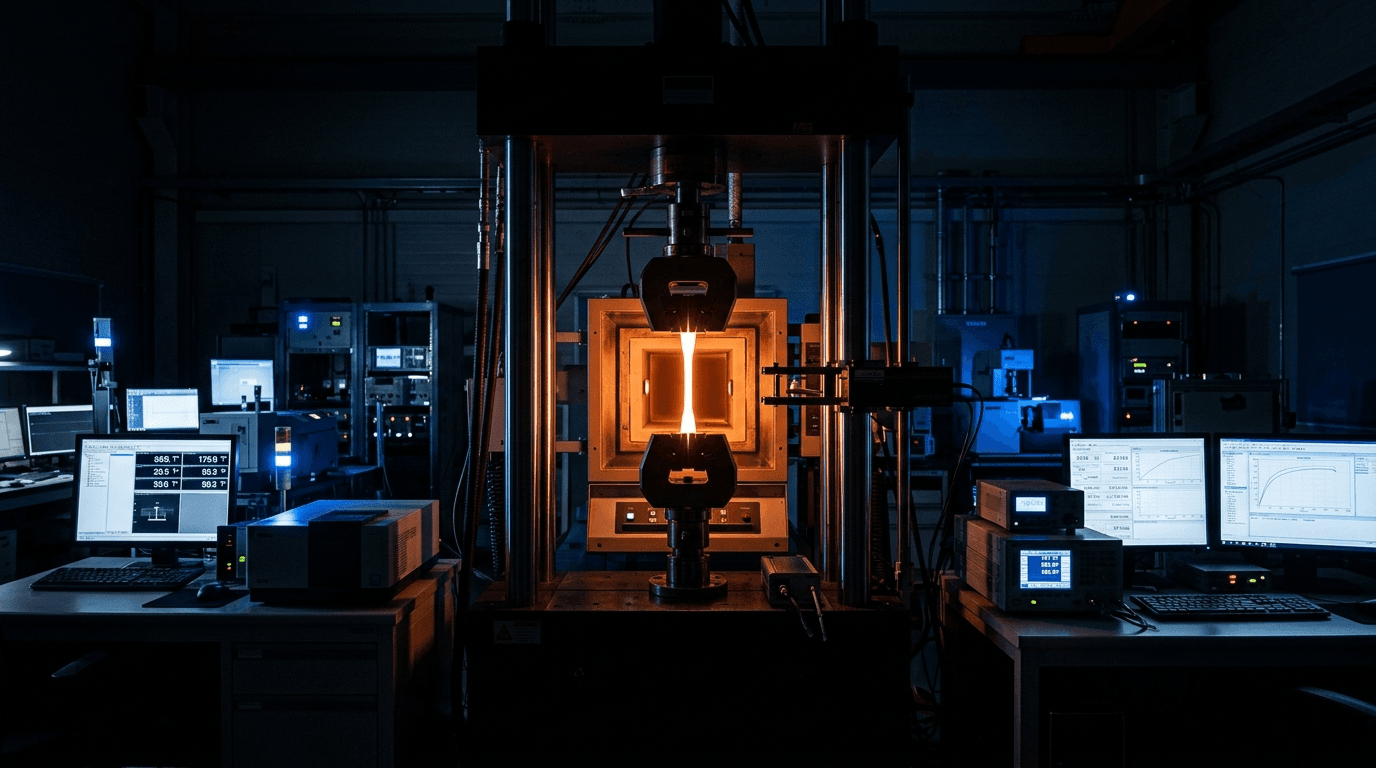
Our scope of accreditation under the Korea Laboratory Accreditation Scheme (KOLAS) covers 25 test items, and we perform demanding tests in-house, including thermomechanical fatigue (TMF), fracture toughness and fatigue crack growth rate (FCGR) testing. KOLAS is a signatory to the ILAC Mutual Recognition Arrangement (ILAC MRA), which facilitates the acceptance of accredited test reports in other signatory economies.
Accreditation
KOLAS-accredited testing laboratory (Accreditation No. KT921)
Accredited tests: tensile testing at room, elevated and low temperatures; creep testing; low-cycle fatigue (LCF) and high-cycle fatigue (HCF) testing; TMF testing; KIc and JIc fracture toughness testing; FCGR testing; Charpy impact testing at room, elevated and low temperatures; and Vickers and Rockwell hardness testing. This capability is core infrastructure for ensuring reliability in power generation, aerospace and defense.
- Tensile testing (room, elevated and low temperatures)
- Creep testing
- Fatigue testing (LCF, HCF)
- TMF
- KIc
- JIc
- FCGR
- Charpy impact testing (room, elevated and low temperatures)
- Hardness testing (Vickers, Rockwell)
The scope of accreditation covers 25 test items in six categories: tensile, creep, fatigue, fracture, impact and hardness.
5-Step Process
Mechanical Testing
Six mechanical test types
From tensile testing to instrumented indentation, we quantify the mechanical properties of materials in accordance with recognized test procedures.
UTS · YS · Elongation
Quantifies tensile behavior at room and elevated temperatures, including yielding and fracture behavior.
Larson–Miller parameter (LMP) · Robinson's life-fraction rule
Evaluates deformation and time to rupture under sustained stress at elevated temperatures.
S-N · LCF · HCF · TMF
Evaluates fatigue life under cyclic loading, including high-temperature thermomechanical fatigue (TMF) testing.
KIc · JIc · Master Curve
Toughness evaluation using C(T) and SE(B) specimens, plus fatigue crack growth rate (FCGR, da/dN) testing.
Absorbed energy at low and elevated temperatures
Analyzes the ductile-to-brittle transition temperature (DBTT) and toughness variation with temperature.
IIT (instrumented indentation)
Vickers and Rockwell hardness testing, plus estimation of mechanical properties by instrumented indentation testing (IIT).
Materials Database
High-temperature materials database — MMPDS
Following MMPDS (Metallic Materials Properties Development and Standardization) data development guidelines, we have built a materials database covering 10 or more superalloys for gas turbines. We provide reliability validation data to Hanwha Aerospace, Doosan Enerbility and the aerospace and defense sectors.
- IN738LC
- IN718
- 17-4PH
- Ti-6242
- Single crystal (SX)
Hydrogen Embrittlement Evaluation
Hydrogen embrittlement testing infrastructure
Using an in-house-built autoclave (max. pressure 172 bar / 2,500 psi; max. temperature 340 °C; flow rate 7 mL/min, up to 10 mL/min), we prepare specimens by electrochemical hydrogen charging at high temperature and pressure. Hydrogen effects are then evaluated through slow strain rate testing (SSRT), creep, FCGR and Charpy tests, together with fracture surface analysis by scanning electron microscopy (SEM).
See details in Industries › Hydrogen & renewables- Max. pressure
- 172 bar(2,500 psi)
- Max. temperature
- 340 °C
- Flow rate
- 7 mL/min(max. 10)
- Test set
- SSRT · Creep · FCGR · Charpy
Testing Infrastructure
Testing infrastructure at a glance
25 units · 9 types
Microstructural analysis
SEM · Laser microscope · EDS · IIT
35 units · 10 types
Mechanical testing
Tensile · Creep · Fatigue · TMF · FCGR · Impact
We also operate specialized equipment for advanced testing, including a high-temperature test system and equipment for Master Curve and subsize specimen testing.
View the full equipment listScope · Deliverables · Standards
Scope, deliverables and standards
| Item | Details |
|---|---|
| Applicable equipment / industries | Superalloy components for gas turbines and aero-engines, power generation and defense materials, railway wheels (EN 13262) and rails, hydrogen piping materials / Hanwha Aerospace, Doosan Enerbility, aerospace and defense |
| Deliverables | KOLAS-accredited test reports, materials property database (following MMPDS data development guidelines), test analysis reports and charts auto-generated by PIMP (PILETA Intelligence Materials database Program) |
| Applicable standards | ISO/IEC 17025:2017 (KOLAS Accreditation No. KT921), MMPDS (aerospace materials data), ASTM (standard da/dN fitting for fatigue crack growth; ASTM G99-23 pin-on-disk), EN 13262 (railway wheels), MIL-HDBK-1823A (probability of detection (POD) specimens), KS/ASTM/EN code standardization (PiletaMDM) |
Ready When Reliability Matters
When integrity needs proof, PILETA delivers
The PILETA Test & Evaluation Center is accredited by the Korea Laboratory Accreditation Scheme (KOLAS) as a testing laboratory (Accreditation No. KT921). From testing and failure analysis to digital solution consultations, our engineers respond to you directly.
T. +82-42-368-0180 · pileta@pileta.co.kr