
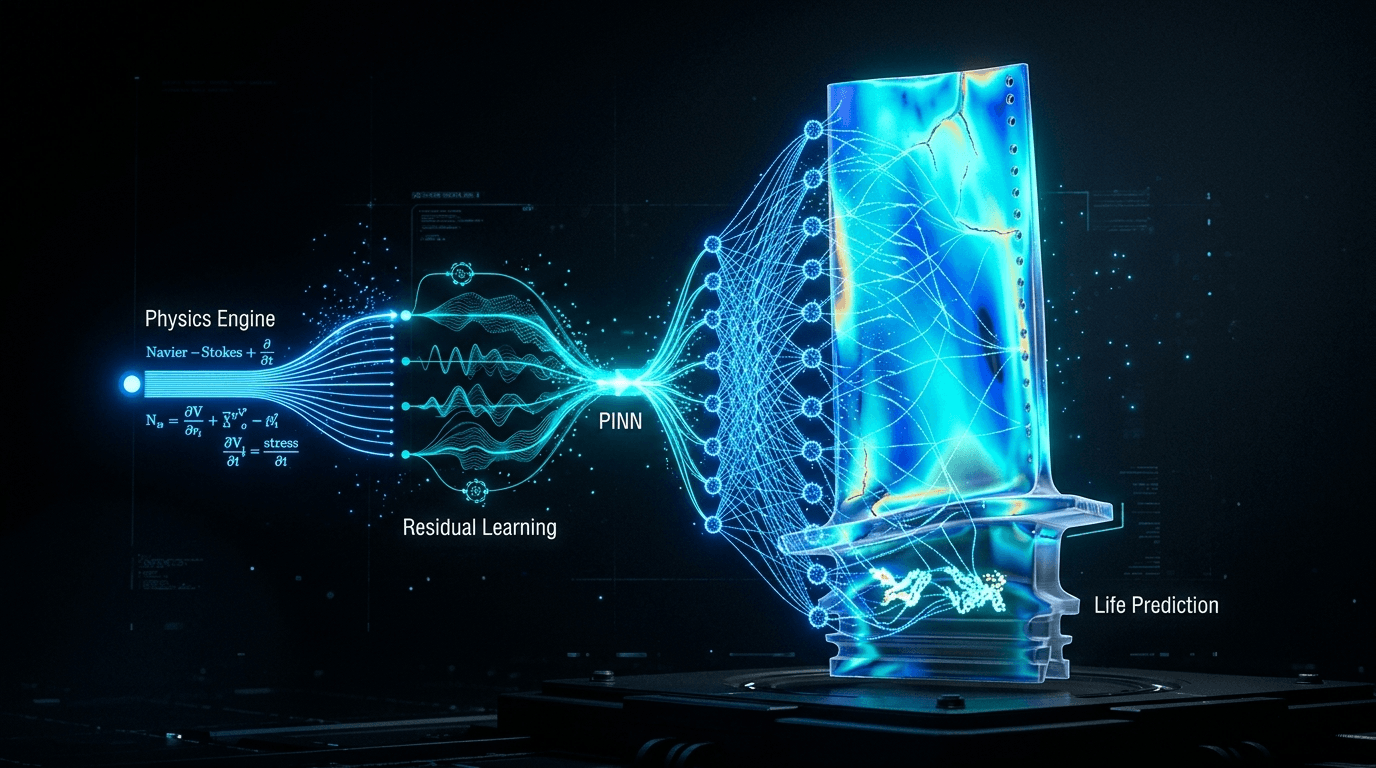
Physics-Informed Neural Network
Physics first, AI on top — hybrid life prediction
An integrated life prediction system for pressure parts that fuses physics-based damage analysis with an AI error-correction model trained on operating history, materials testing and nondestructive testing (NDT) data. It addresses both the conservatism of deterministic methods and the extrapolation instability of AI.
Four Integrated Modules
Four core modules
Physics-based analysis, AI residual correction, flow-accelerated corrosion (FAC) wall thinning prediction and a real-time diagnostics platform combine into a single integrated life prediction system for pressure parts.
Physics-based damage analysis
Physics Damage Engine
- High-fidelity 3D stress fields computed by finite element analysis
- Metal temperature based on a Green's function database
- Cumulative fatigue and creep damage assessment
Physics-informed AI
Hybrid Residual Learning
- Dual structure of a physics engine and a residual branch
- Training that enforces governing physical laws
- Uncertainty quantification
FAC wall thinning prediction module
Flow-Accelerated Corrosion
- FAC prediction model based on international standards (covering both single- and two-phase flow)
- Calculation of wall thinning rate, remaining wall thickness and ultrasonic testing (UT) inspection interval
- Field calibration against UT measurements
Real-time diagnostics platform
Digital Twin · OPC UA
- Digital twin simulator for heat recovery steam generators (HRSGs)
- 3D risk map and time-series alarm GUI
- Active-standby, high-availability redundant servers
Architecture — Dual-Branch Hybrid
Dual-branch design: physics engine + residual branch
The physics-based damage analysis engine computes a baseline solution, and a Physics-Informed Neural Network (PINN) learns only the residual against measured data to correct it. A physics constraint loss prevents non-physical predictions, and uncertainty is quantified.
Branch 1 · Physics
Physics-based damage analysis engine
Computes a baseline solution from finite element stress fields, metal temperatures and cumulative damage.
Branch 2 · AI Residual
PINN residual learning
Learns only the residual against measured data, while a physics constraint loss prevents non-physical predictions.
Merged Output
Corrected life prediction · uncertainty quantification
The FAC module is calibrated in the field against UT measurements, and results are fed to the digital twin platform in real time via OPC UA.
FAC closed loop — prediction → UT measurement → calibration
Wall thinning predictions are calibrated against field UT measurements in a closed loop, continuously improving prediction accuracy.
Key Differentiators
Three key differentiators
Physics + AI dual structure
Enforcing physical laws mitigates the extrapolation instability of AI-only models, with uncertainty quantification.
Calibration against UT measurements
A closed-loop structure that corrects FAC wall thinning predictions with field measurements.
High-availability real-time platform
Active-standby redundancy with a 3D risk map and time-series alarm GUI, ready for use in plant operations.
Impact
Expected benefits
- Supports the transition to predictive maintenance by predicting pressure part damage in advance
- Optimized UT inspection intervals (FAC module)
- Faster decision-making through digital twin–based risk visualization
Status & Applications
Applications and status
PINN AI Hybrid is in progress as a flagship project of Phase 3, PHM Hybrid (prognostics and health management), on our technology roadmap, alongside BSE (Boiler Safety Evaluation) and the FAC module. It is being developed on the data foundation built up through BSE and HRSG DAS (HRSG Data Acquisition System).
Ready When Reliability Matters
When integrity needs proof, PILETA delivers
The PILETA Test & Evaluation Center is accredited by the Korea Laboratory Accreditation Scheme (KOLAS) as a testing laboratory (Accreditation No. KT921). From testing and failure analysis to digital solution consultations, our engineers respond to you directly.
T. +82-42-368-0180 · pileta@pileta.co.kr